
Virtual Reality in Nursing Classes
October 17, 2025
By Cynthia Rutz, Director of Faculty Development, CITAL
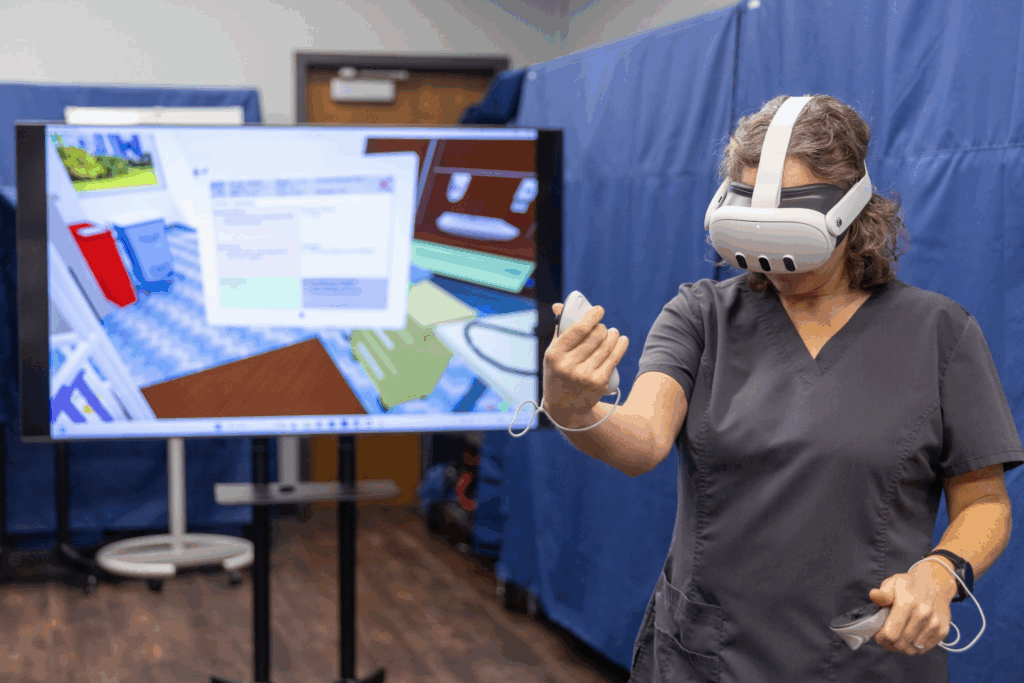
A nursing student wearing a virtual reality (VR) headset as they take the vitals of a virtual patient? This scenario is not science fiction but science fact at our College of Nursing and Health Professions (CONHP). To find out more, I interviewed three Valpo faculty who are piloting VR in our nursing classes: Karen Hernes, Bailey Regier, and Grace Gass.
Using VR in our Nursing program began with a 2023 grant from the Health Resources & Service Administration. Faculty used grant funds to attend the 2023 conference of the International Nursing Association for Clinical Simulation and Learning (INACSL). At the conference they observed many VR demonstrations and met lots of vendors.
They ultimately chose to partner with SimX, a VR medical training company that also works with the military, police, and EMS. For the pilot phase, they used the grant to purchase a three-year licensing fee with SimX. After the conference, Bailey went on to research how other nursing programs are using VR. However, since this is new technology in the field, there was hardly any data. So Karen, Bailey, and Grace came up with their own program, and they began to pilot VR in their courses in the fall of 2024, exposing over 150 nursing students to VR.
Karen used VR for one of her large lecture classes. For this class, Bailey wore the headset for the first VR lesson. For later lessons students would be in the headset. The students worked in teams of 5-6 using the interactive learning program Top Hat. On a screen, the team members could see and hear what Bailey was experiencing with her headset, including patient sounds such as breathing and heartbeat. The teams would then tell Bailey what to do next and she would do it, whether taking vitals or calling in the doctor. The patient would give some scripted responses and those responses would then guide the next Top Hat question for the team.
In a pediatric nursing course, Grace used VR in smaller group sessions of 6-8 students outside of class time. She put four students at a time in the headset, with the other team members collaborating by following along on the projected screen. Students were exposed to some pretty realistic scenarios, such as a patient who had been poisoned or had a rare heart condition. The four students observing each had specific roles such as documenting treatment or doing the math to figure out medication amounts. Students found the experience collaborative and engaging.
Faculty have also found that VR can help with one of the scariest scenarios for a new nurse: a patient having a seizure. While using the VR headset, one student froze when they experienced their first simulated patient seizure. This is a perfectly natural reaction, but it is so much better for a student to experience it first virtually, so that when a real patient seizes they will be more prepared for it.
VR works particularly well in longer lab sessions. Bailey and Karen both teach a skills lab from 7:00 a.m.-11:30 a.m. In the past, they would always end with a case study that they would put up on the screen. But coming at the end of such a long session, students sometimes checked out at that point. Instead, they now pull up a VR patient scenario fitted to what was discussed that day. One student puts on the VR headset for 10-15 minutes and the rest can see the scenario projected on the large screen. Then they collectively guide the student in the headset and come up with a care plan from the data collected. The patient scenario differs every week, so students are engaged because it feels more like a game.
During this pilot year, faculty collected data on both the usability of the technology and how effective the simulation was. The usability scores were higher than they had expected. Students also reported that the simulation improved their learning and made them feel more confident.
Valpo is very much ahead of the curve in implementing VR for nursing. Last year, our faculty gave several presentations on their VR data at conferences, including the ATI National Nurse Educator Summit. Many colleagues from other universities came up to them afterwards wanting to know more. One said that they had purchased VR headsets for their program, but the headsets just sat on the shelf.
The hope is that, in the future, every clinical course will have an immersive VR component. The college now has a dedicated room for VR, so groups of up to eight students can use it at a time. Eventually, they plan to incorporate VR in every year of their program.
______________________________
A Student’s Perspective
By Soniya Ottayil, Senior Nursing Major
I was excited to use virtual reality (VR) for the first time in my nursing courses last year. We participated in one VR session for each nursing class, working in small groups. My first impression was that VR is user-friendly and that the graphics were remarkably realistic, mimicking an actual hospital room and medical equipment.
In my first VR session, one group of students used the VR headset, performing assessments and interventions for the patient, while the second group observed the session on a monitor and fulfilled specific roles. For example, if a student in the VR simulation had questions about the rate at which a medication should be administered, the designated resource nurse in the second group provided assistance. During the epilepsy VR simulation, one student observer served as the safety nurse, responsible for documenting the safety interventions being implemented by the VR student to protect the patient experiencing a seizure. These structured roles for observers helped me be engaged in what the VR group was doing and to help them as needed.
Once the time was up, the students switched places so that both groups could experience using the VR headset. Once both groups had completed the simulation, we engaged in a debriefing session. This reflection process was very helpful, as it allowed us to discuss what we had performed well and to identify areas for improvement.
One drawback was that some students experienced dizziness and nausea after these sessions. But aside from this minor issue, I did not notice any significant challenges with VR.
Overall, I believe virtual reality enhances nursing education by allowing students to experience realistic clinical scenarios in a controlled setting. Based on my clinical experiences, VR also provides an accurate visual representation of the room and equipment. Most importantly, this experience fostered team work as we collaborated to provide the best possible care. I hope that the College of Nursing and Health Professions continues to integrate VR into their curriculum and encourages other disciplines to adapt it as well since it is such an effective learning tool.